Researchers have designed aerial robots that can perch on various surfaces, according to a new study. The robots’ perching ability allows them to rest which reduces energy consumption. Dipti Kapadia reports. Photo: AAAS
Fruit flies are far from human, but not as far as you might think.
They do many of the same things people do, like seek food, fight and woo mates. And their brains, although tiny and not set up like those of humans or other mammals, do many of the same things that all brains do — make and use memories, integrate information from the senses, and allow the creature to navigate both the physical and the social world.
Consequently, scientists who study how all brains work like to use flies because it’s easier for them to do invasive research that isn’t allowed on humans.
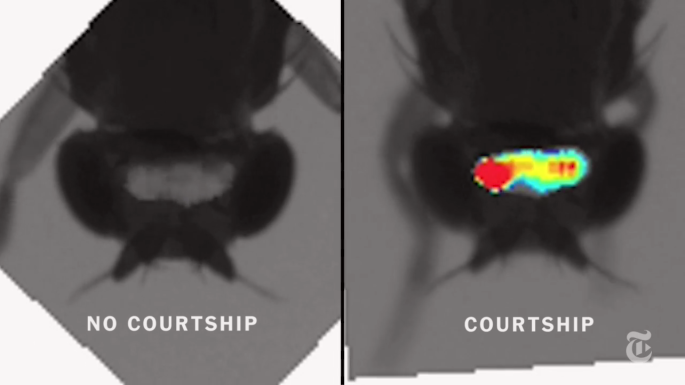
The technology of neuroscience is sophisticated enough to genetically engineer fly brains, and to then use fluorescent chemicals to indicate which neurons are active. But there are some remaining problems, like how to watch the brain of a fly that is moving around freely.
It is one thing to record what is going on in a fly’s brain if the insect’s movement is restricted, but quite another to try to catch the light flash of brain cells from a fly that is walking around.
Takeo Katsuki, an assistant project scientist at the Kavli Institute at the University of California, San Diego, is interested in courtship. And, he said, fruit flies simply won’t engage in courtship when they are tethered.
So he and Dhruv Grover, another assistant project scientist, and Ralph J. Greenspan, in whose lab they both work, set out to develop a method for recording the brain activity of a walking fly.
One challenge was to track the fly as it moved. They solved that problem with three cameras to follow the fly and a laser to activate the fluorescent chemicals in the brain.
The other was the delicate matter of making a window into the fly’s brain. For that, Dr. Katsuki said, he removed the top of a fly’s head and glued in place a tiny glass window. It had to seal off the brain so that it wouldn’t dry out, and it had to be flat, to avoid optical distortion.
The procedure was quite a delicate matter. Now, Dr. Katsuki said, “I call myself a fly surgeon.â€
And although the flies often seemed fine after the procedure and walked away, the researchers let them rest for a day, to make sure. If the surgery did not go well, a fly’s brain activity might be abnormal, and if there was a problem, a fly would probably not survive a day.
Dr. Katsuki said that he was sometimes disappointed when surgery went well but the patient escaped by flying away instead of being captured in a vial to await the next day’s experiment. But he and his colleagues operated on enough flies to prove the value of the procedure.
The researchers published the details of their work in Nature Methods in May. Now that they have shown the approach works, they can start finding out what they want to know about how a fly’s brain works.
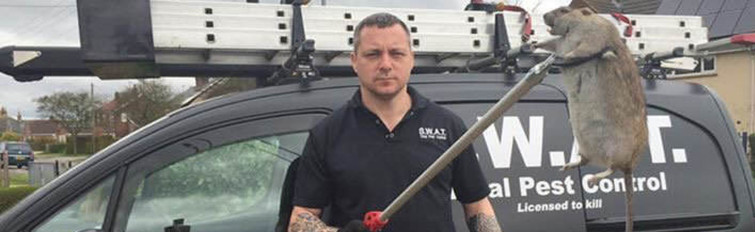
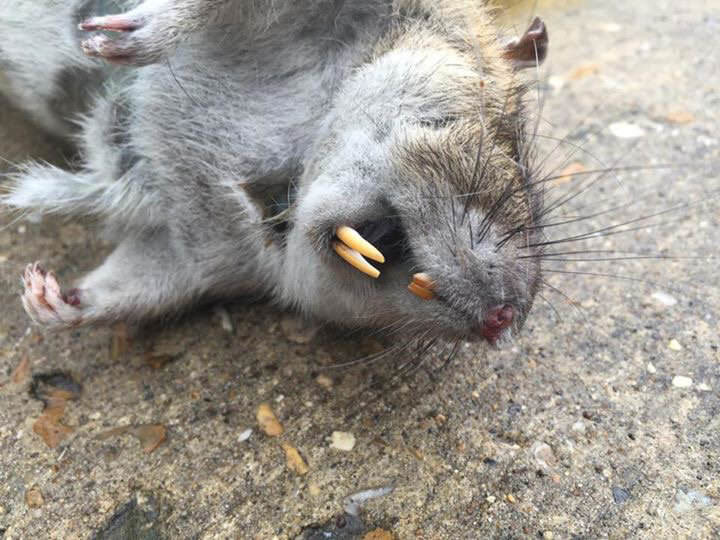
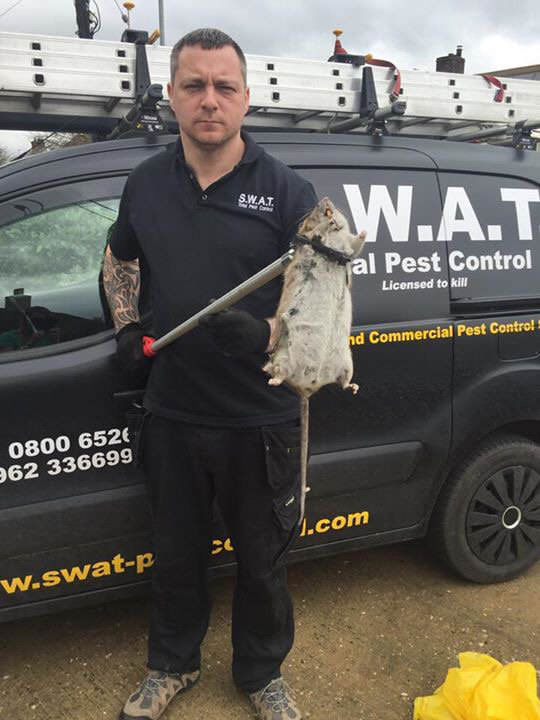
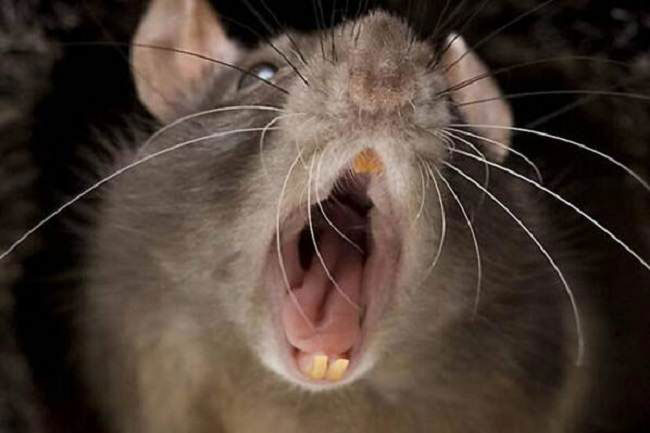
You might remember all the fuss over the ‘giant rat’ found in London a little while back, well this one would certainly give it a run for its money. The rodent – which measures in at two feet long – was captured at someone’s home in Humberston, Grimsby, after pest controllers were called in to deal with reports of the vermin scuttling along their patio. Grim.
The owner of S.W.A.T. Total Pest Control, Jeff Sullivan, 58, confirmed that this is the biggest rat he’s encountered in his 18 year career in the sector.
He said:
” There is a lot of misrepresentation with guys taking photos of rats with mobile phones and holding it out at an extreme arms-length to create the illusion that it’s bigger than it really is. But this is the real deal, it’s the largest rat I’ve ever seen.
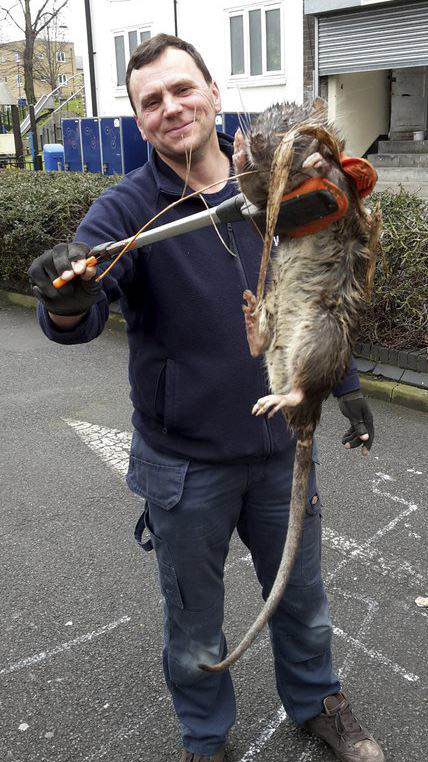
He’s referring to the four foot rat found in London not too long ago, which actually turned out to be a trick of perspective and was only two feet long.
Just to make this a bit more terrifying, it sounds like this could become a much more regular occurrence, as they predict there is a plague of ‘super rats’ in the UK.
Usually Britain’s rodent population is decimated by the cold, but due to the mild winter weather this year, the rats spent the colder months eating and growing in size, reports The Mirror.
A view echoed by Jeff, who revealed that the rats are eating high-protein food to bulk up to their insane size and are also becoming almost impossible to kill with traditional rat poisons.
This particular rat was caught using traps, which is the most eco-friendly way of dealing with vermin.
We’re not exactly thrilled that these giant rats now seem to be an actual thing- it’s definitely not something I want to encounter in my kitchen anytime soon!
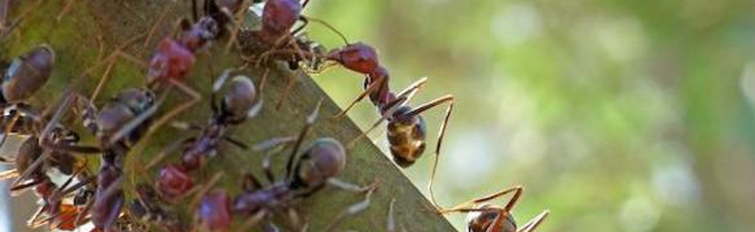
Ants use their antennae to send and receive messages. Scientists believed ant antennae were like human ears — designed to receive communication signals. Researchers from University Of Melbourne found ants also use their antennae to send signals.
Biologists made the discovery while studying changes in surface chemistry during ant interactions. The bodies of ants — like bees, beetles, flies and wasps — are coated in cuticular hydrocarbons, CHCs, wax-like chemical compounds that protect insects from dehydration and aid in communication.
When the Melbourne scientists stripped the CHCs from an ant’s antennae the insect became unrecognizable to the rest of the colony.
The phenomenon suggests antennae help ants deliver key information about who they are and where they’re from to their peers.
“An ant’s antennae are their chief sensory organs, but until now we never knew that they could also be used to send out information,” researcher Qike Wang, a PhD student at Melbourne, said in a news release. “Like everyone else, we assumed that antennae were just receptors, but nature can still surprise us.”
Wang and his research partners also found different parts of the ants’ bodies featured different mixtures of CHCs. Their findings — detailed in the journal Proceedings of the Royal Society of London B — suggest different parts of the body can deliver different pieces of information.
“Compared to visual or acoustic signals, we know rather less about chemical signals, and one reason might be that we are analyzing a mixture of different signals,” Wang said. “What we’d like to know is what more they might tell us.”
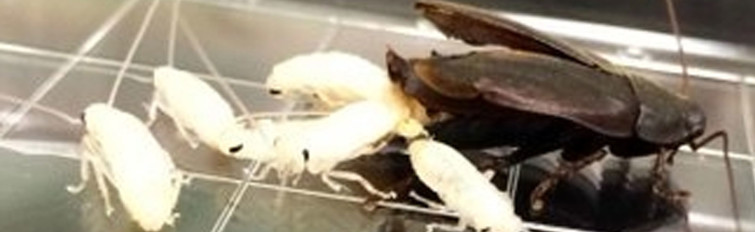
Researchers hope to uncover the genetic mechanisms that take place during cockroach pregnancy and use this knowledge to better understand human pregnancy. The first-ever sequencing of a cockroach genome species, Diploptera punctate, has been created by researchers at the University of Cincinnati and may help scientists create a research model similar to current models that utilize data from mice and apply it to humans.
In this case, the model could reveal the effects of stress during pregnancy on both the mother and daughter. The researchers extracted ribonucleic acid (RNA), which is found in the cells of every living organism that inhabits the Earth, and created a gene readout to examine the stages of changes that take place during cockroach pregnancy and examine if these changes can be applied to other mammals.
“When I started this project two and a half years ago, we might have had a maximum of 80 sequenced genes for this animal,” Emily Jennings, who conducted the research, said in a press release. “Now, we’ve found as many as 11,000 possible genes. We’re in the process of assigning functions, roles and names by comparing sequences to sequenced genomes, such as that of the fruit fly, stored in the database of the National Center for Biotechnology Information.”
“We’re on the edge of creating an exciting new resource for examining how a mother nourishes her babies before birth, a process typically associated with mammals,” she added.
During pregnancy, the D. punctate cockroach creates a unique milky secretion that provides its embryos with various essential nutrients including proteins and carbohydrates, a process that is comparable to how pregnant mammals utilize placentas. Jennings’ research will focus on the gene expression that takes place during the pregnancy process and examine the possibility of the presence of genes that start or stop the pregnancy.
“Ultimately, our next step will be looking at how interaction between the mother and the embryos can be affected, so if the mother is stressed during pregnancy – such as being exposed to a toxin or being deprived of resources such as food and water – we want to see how that can affect development of the embryos,” Jennings said.
The findings are currently being presented at the annual national meeting of the Society for Integrative and Comparative Biology in Portland, Ore., until Jan. 7.
Source: HNGN – Headlines and Global News Writer: Tyler MacDonald
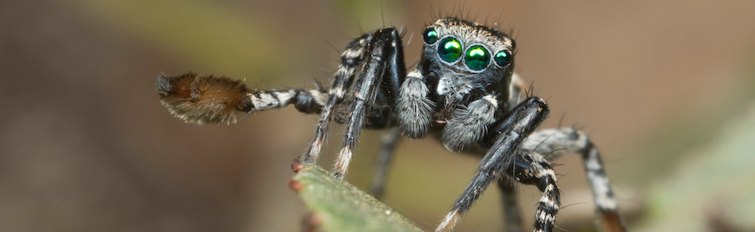
Males of the human variety may spend hours at the gym bulking up to attract the ladies, but that’s nothing compared to the efforts of a new spider species from Australia.This little brown spider sports a massive, paddlelike appendage on its legs that it flashes at females to woo mates, new research has revealed.
The new spider species, Jotus remus, can do this paddle “peekaboo” routine for hours, all to get female spiders to accept its advances. The paddle seems to be a way of separating the fertile females from those that have no interest in mating, said Jürgen Otto, the biologist who discovered the oddball spider.
Camping stowaway
Otto has a day job researching mites at the Australian Department of Agriculture and Water Resources in Sydney, but spends his free time hunting down gorgeous and unusual peacock spiders. (Otto maintains a YouTube channel filled with videos of the bizarre mating dances of peacock spiders.) He first discovered J. remus, while on a camping trip with his family during Christmas break in 2014. While unpacking the car after the trip, he spied an ordinary-looking brown spider sitting on his tent bag.
“At first it didn’t seem really unusual. It had color, patterns and shapes I’ve seen before,” Otto told Live Science. “But I looked closer and noticed it had these funny extensions on their third pair of legs, it seemed like a paddle.”
Otto suspected the creepy crawly was a new spider species, but had no idea what the paddle was for. And finding out posed a bigger problem: He wasn’t sure whether the spider lurked in the wilderness around his home or was a stowaway from his campsite at Barrington Tops National Park, about 125 miles (200 kilometers) north of Sydney.
Eventually, Otto returned to his camping location and noticed several of the spiders on a walking trail he’d visited during the trip. He suspected the darker brown arachnids were the females, so he scooped some of those up, as well as additional males and put individual males and females together with some twigs and leaves to see what they did.
Hide-and-seek
The male spider quickly hid behind a leaf as the female spider watched.
“From under the leaf he stretched out one of his legs, of the third pair,” Otto told Live Science. “He exposed that paddlelike extension to her and waved it at her.” The female occasionally lunged toward the male spider. The male handily evaded her.
“He seemed to have no difficulty at all escaping from these attacks; he seemed to be playing a game,” Otto said.
This seemingly pointless game of hide-and-seek went on for many minutes until the male gave up. Otto tried the same thing with multiple females and male piders. Perhaps the male was trying to exhaust the females, to make them more receptive to his mating advances, Otto said he thought. But the females didn’t seem to get tired, no matter how long the male persisted. Like the male spider, Otto eventually set aside the peekaboo game and pursued other spider questions.
Like a virgin
But a few months ago, some of the immature females of J. remus grew up. These spider females were “virgins” who had had no opportunity to mate with males. In these types of spiders, females can probably only mate once, so non-virgin females are of no use for males looking to pass on their genes, Otto said.
When Otto put the male spider together with the virgin female spider, the male went ahead with his paddle routine. But the female, rather than lunging at him, watched curiously. Within a few minutes, the female became very calm and still. At that point, the male spider made his move, emphatically thrusting his paddle twice.
“After those two vigorous paddle strokes, he just jumped up very quickly to the other side of the leaf and went on mating with that female,” Otto said.
So the paddle dance seemed to be an elaborate way for male spiders to figure out if a prospective female is “the one,” Otto said.
“The one that keeps attacking him is not the right one,” Otto said. (Probably good advice for males of any species.)
Questionable behavior
While Otto has never seen a female spider eat a male, the females are superb hunters and the males of the species are significantly smaller than the females, “just the right size for him to be food,” Otto said. As such, the elaborate paddle game may partly be a protective mechanism, a way for males to avoid risking danger with a female who has no interest. Still, the males are swift and never seemed to be truly threatened by the females, and the whole encounter seems almost playful, so there could be another explanation for the male spiders’ sneaky moves, he added.
One question still puzzles Otto: Why do the males play so long with partners who clearly have no interest?
“If the male gets a reaction from the female telling him she is not really happy to mate with him, why does he keep on trying?” Otto said. “There’s a lot of play going on that seems to be wasted energy.”
Otto and his colleague David Hill, a zoologist in Greenville, South Carolina, described J. remus in a paper that was published online Jan. 7 in the journal Peckhamia.
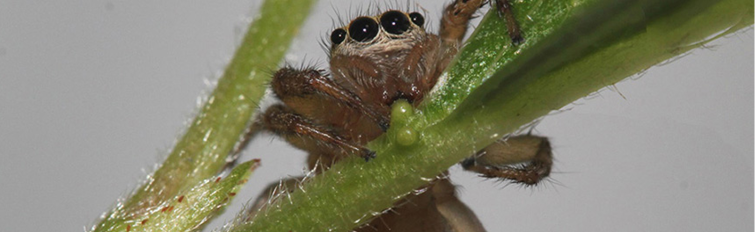
Spiders eat insects. That’s why some of us are reluctant to kill spiders we find at home — we figure they’ll eat the critters we really don’t want around. But a new study reveals that the spider diet is far more diverse than we learned in elementary school. Spiders are insectivores, sure, but many also have a taste for plants.
Only one species of spider is known to be completely vegetarian. Bagheera kiplingi jumping spiders of Mexico survive mostly on bits of acacia trees, Science News reported in 2008. And while scientists have yet to find any other vegetarian species, plant-eating appears to be very common, particularly among jumping spiders and spiders that make webs outdoors.
Martin Nyffeler of the University of Basel in Switzerland and colleagues combed books and journals for reports of spiders consuming plant material. There is evidence of veggie-eating among more than 60 species of spiders, representing 10 families and every continent but Antarctica, the team reports in the April Journal of Arachnology.
Perhaps past scientists can be forgiven for overlooking the plant-eating behavior, as spiders can’t eat solid material. They have a reputation for sucking the juices out of their prey, but that’s not quite the right description. Instead, a spider covers its prey with digestive juices, chews the meat with its chelicerae and then sucks the juices in. This eating style means, though, that spiders can’t just cut a piece of leaf or fruit and chow down.
Some spiders feed on leaves either by digesting them with enzymes prior to ingestion (similar to prey) or piercing a leaf with their chelicerae and sucking out plant sap. Others, such as the vegetarian Bagheera kiplingi, drink nectar from nectaries found on plants or in their flowers. More than 30 species of jumping spiders are nectar feeders, the researchers found.
“During such [feeding], the spiders were seen pushing their mouthparts deep into flowers to drink nectar, similar to the way nectar-drinking insects feed,†the researchers write. And this isn’t accidental behavior — some spiders can feed on 60 to 80 flowers in an hour.
Pollen is probably another common plant-based food source for spiders, especially those that make webs outdoors. That’s because spiders eat their old webs to recycle the proteins. And when they eat their webs, they eat anything that might be caught on the sticky strands, such as calorie-rich pollen. Spiders might also be consuming tiny seeds and fungal spores this way, though the latter may be a risky meal as there are many fungi whose spores will kill spiders.
The researchers also found some cases of spiders intentionally eating pollen and seeds, and they also note that many spiders are eating plant material when they munch on plant-eating insects. Just how common plant-eating is among spiders isn’t yet known, but it could be even more common, especially among species that create webs outdoors.
“The ability of spiders to derive nutrients from plant materials is broadening the food base of these animals,†Nyffeler says. “This might be one of several survival mechanisms helping spiders to stay alive for a while during periods when insect prey is scarce.â€
And with reports of spiders eating a whole menu of other non-insect foods — including crustaceans, earthworms and small vertebrates in the wild; and sausage and soy milk in the lab — it’s clear that we need to call them something other than insectivores.
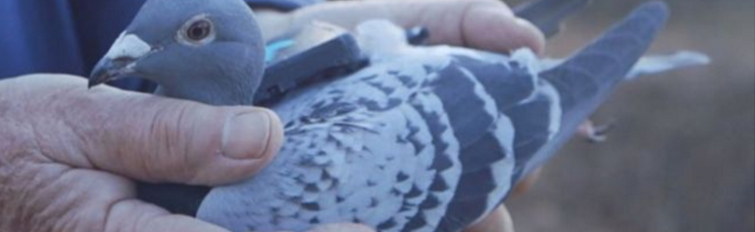
A technology company has released ten pigeons wearing lightweight sensors to monitor pollution in London.
Plume Labs has fitted the birds with tiny backpacks which monitor nitrogen dioxide, ozone and volatile compounds.
Until Wednesday people can tweet their location to @PigeonAir and can find out how much pollution is registered in their area.
Who’s fighting air pollution? Pigeons. Wearing tiny backpacks with pollution sensors!
It is also possible to view the pigeons’ flight movements on a live map.
The idea was originally submitted by Pierre Duquesnoy and Matt Daniels, of marketing and technology agency Digitas LBi, to Twitter’s #PoweredbyTweets competition.
Racing pigeons
It was the winning entry in the “Solve a Problem” category and was exhibited during the London Design Festival at Somerset House.
Racing pigeons are being used for the project, with a vet on hand to check the pigeons do not suffer any distress.
Plume Labs said 10,000 people die from air pollution each year in London alone.
It said it hopes to “show Londoners how air pollution affects them, especially during rush hour” using the pigeon air patrol service.
The campaign aims to encourage Londoners to become beta testers for a wearable version of Plume Labs’ air pollution measuring device.
You don’t build the world’s biggest bird nests by putting up with lazybones. That, anyway, is the finding of a new study into how sociable weavers (Philetairus socius) make and maintain nests that can house up to 500 birds. Aggressive supervisors identify and punish the slackers while constructing the giant, grass-woven structures in southern Africa. (Take National Geographic’s bird quiz.)
Birds that shirk their duties on creating the nest’s main thatch structure, and focus instead on their individual chambers, are chased away from the nest, according to the study, published March 16 in the journal PLOS ONE. But when the lazy birds return, they’re much more cooperative, the researchers found during National Geographic Society-supported fieldwork at the Brink Research Site in Namibia in 2014.
Study co-author Gavin Leighton believes the pushy birds in the weaver colony help to pull it together for the common good.
“The aggression inducing this nest construction, given it’s such a constant behavior that we see, could very well lead to these large nests,†says Leighton, a postdoctoral fellow at the Cornell Laboratory of Ornithology in New York.
Potential Freeloaders
Weighing up to a ton or more and up to 20 feet (6 meters) wide, the nests are home to a number of extended families that have their own chambers for roosting and breeding. (Related: “5 Animals That Are Awesome Architects.”)
The idea is “very interesting,†he says, but “it seems to me that this is unlikely to be driving communal nest-building.†According to van Dijk’s observations, “aggressive interactions seem to be relatively rare,†while “thatch building is only performed by about 50 percent of birds, mostly males. There are thus a lot of freeloaders that would need to be punished for not contributing to the thatch.â€
He also questions how the dominant birds can “monitor the behavior of, say, 300 birds in a typical colony.†But Leighton says has seen nest-builders take frequent time-outs on a nearby branch. “It’s possible that they’re keeping tabs on the other individuals in the colony,†he says. (Read more about Gavin’s research in his own words.)
If the study findings are correct, sociable weaver nests may get even bigger than they need to, adds Matthieu Paquet of the University of Edinburgh in the U.K. “If coercion plays a role, we can imagine birds building more than is actually necessary to avoid aggression,†he says.
A First for Birds
Leighton says his study marks the first known case of a bird using aggression to boost cooperation for the good of the group. Such behavior is rare in social animals, he adds, with the few reported examples including the naked mole-rat, a species that likewise dishes out punishment to group members that need to pull their socks up. (See “5 of Nature’s Wildest Animal Showdowns.”) There’s also us humans, of course. Leighton compares the sociable weaver nest to an apartment complex.
“Individuals who contribute the most to maintaining the shared part of the complex are the most aggressive, and the individuals that work most on their own rooms receive the most aggression,†he says. But when sociable weavers are angrily shown the door, at least they know there’s a way back.
Writer: James Owen Source: News, National Geographic
Bird feces piling up on power lines is the most likely reason behind the latest shutdown of the Indian Point reactor in New York, a state-commissioned probe into the incident at the aging nuclear power plant has revealed after months of investigation.
One of the reactors at the Indian Point nuclear power plant, 25 miles north of New York City, was shut down after a transmission line trouble on December 14.
After months of investigation into the cause of the malfunction that lasted for three days, the plant operator Entergy Corporation now says that the shutdown was likely a result from a string of “large bird†droppings landing on the plant’s electrical equipment.
“Damage was caused by a bird streamer. Streamers are long streams of excrement from large birds that are often expelled as a bird takes off from a perch,†company officials said in last month’s report, obtained by Lohud, part of the USA Today news network.
“If a streamer contacts an energized conductor, the electrical current may travel through the streamer back to the bird or pole/transmission tower. The result may be a bird electrocution, power outage, and/or line trip,†Entergy explained.
Following the investigation, managers at the nuclear plant have started installing bird guards on transmission towers and are now conducting additional inspections and cleanings of the lines.
An Entergy spokesman Jerry Nappi confirmed that the December accident was caused by an “electrical disturbance†on outdoor high voltage transmission lines, stating that the actual cause is “still being reviewed by an outside engineering expert.â€
“A possible cause is bird ‘streaming’,†Nappi said, an issue that is a “common cause†for electrical interruptions in high voltage transmission lines throughout the world. Yet Nappi noted that he couldn’t recall a similar incident in the past several years from birds at Indian Point.
New York Governor Andrew Cuomo has raged a personal vendetta to shut down the nuclear plant that lies within an hour drive of 20 million people. Two days after the December 14 accident, Cuomo ordered the Department of Public Service to investigate a series of unexpected outages.
The Indian Point Energy Center produces some 25 percent of New York City’s and Westchester’s electricity. The combined power generated by the two units amounts to over 2000 megawatts. The facility employs some 1,600 people.